| Brand Name: | Sunshineopto |
| Model Number: | SUN-HB50-24 |
| MOQ: | 100 |
| Price: | negotiate |
| Packaging Details: | Cartons |
| Payment Terms: | T/T,PAYPAL,Western Union,Money Gram |
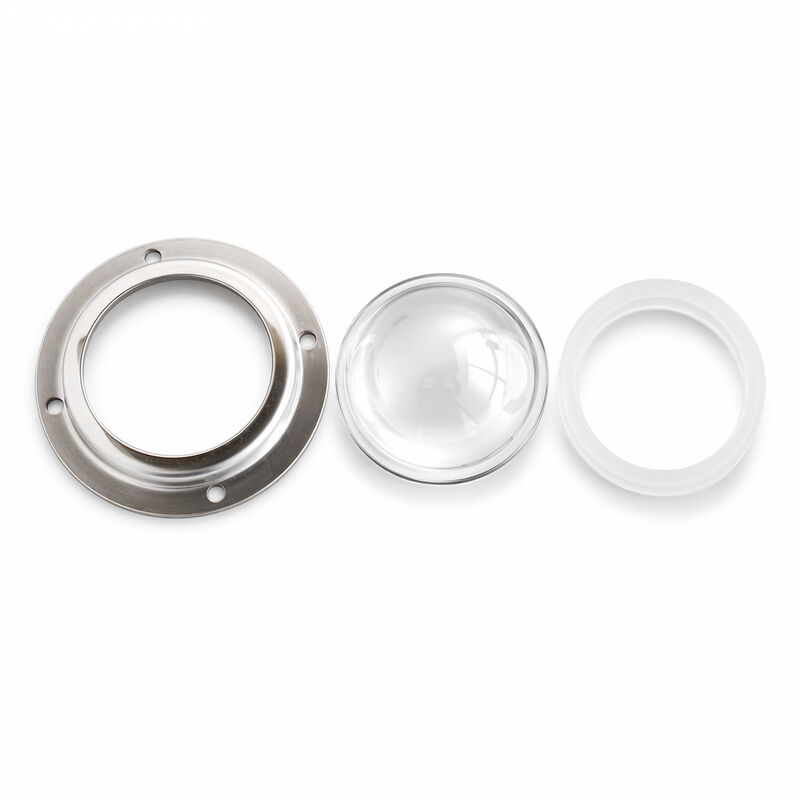
| Kits | Glass lens+silicon gasket+metal holder |
|---|---|
| Model No. | SUN-HB50-24 |
| Lens size | 50mm Diameter |
| Bean angle | 70 - 90 degree |
| Material | Borosilicate glass |
| Transmittance | 93% |
| DHL/UPS/TNT/FEDEX | 4-5 working days |
|---|---|
| EMS | 10-15 working days |
| HK Post Air Mail Register | 15-18 working days |
| Trade Terms | FOB | EXW | CIF | CFR |
| Sample availability | YES |
| Delivery time | 3-4 working days |
FAQ
Q. Why choose borosilicate glass instead of PMMA or PC for a COB LED lens?
Borosilicate glass offers significantly higher heat resistance, superior UV stability, lower thermal expansion, and better long-term optical clarity than most plastic materials, making it ideal for high-power COB LED applications where temperature and durability are critical.
Q. What is the difference between the 70° and 90° beam angles?
A 70° beam angle provides a more concentrated light distribution suitable for spotlights, high bays, and accent lighting, while a 90° beam angle delivers wider illumination that is well suited for floodlights, commercial spaces, and general industrial lighting.
Q. Can you customize the beam angle or lens dimensions?
Yes. We provide OEM and ODM services, including custom beam angles, lens diameters, optical simulations, mounting structures, and complete optical module development to meet specific project requirements.
Q. Is this lens suitable for outdoor lighting?
Yes. The borosilicate glass material offers excellent resistance to UV radiation, moisture, thermal shock, and harsh environmental conditions, making it suitable for outdoor luminaires when integrated into appropriately sealed fixture designs.
Q. Does the lens affect the overall efficiency of the luminaire?
Yes. A high-quality secondary optical lens can significantly improve optical utilization by directing more light onto the target area, reducing stray light, and enhancing system efficacy, thereby improving the overall performance of the lighting fixture.